
🔭 ✨Boring Astronomy: the Foundations for a Bright Future ✨🔭
Behind the Scenes of the Science of the Cosmos
I am Alessandro. I have been in astronomy since 2003.
If you are eager to have a playful attitude towards astronomy; you want to grow your interest in this science and you want to know how astronomy works “behind the scenes”, this is the place for you.
I am planning on sending this Newsletter every Sunday.
Mistakes will be made; I count on your feedback to make this newsletter a better place and provide you with increasingly better content.
You can follow my vlog on TikTok or my YouTube Channel .
You can find Boring Astronomy’s material on Etsy.
📰 This week in Astronomy
This issue of the newsletter brings ideas and analysis which create interesting foundations for the future. New datasets which we can use in the future, crazy ideas for planetary defence, a nice paper about the Small Magellanic Clouds which naturally “calls” for spectroscopy, a new approach on astronomical data, and an analysis of observing time allocation on a big telescope.
“It is difficult to make predictions, especially when it is about the future”, so it will be interesting to get back and check what happened but this issue of the newsletter can be inspiring.
HETDEX DR1
Many of us have been waiting for this data set for a long time. The Hobby Eberly Telescope is a 10m telescope based in Arizona (USA). It is a very peculiar telescope and it is being used for a project called Hobby-Eberly Telescope Dark Energy Experiment (HETDEX) which aims at studying dark energy, the force which is accelerating the expansion of the Universe.
You can find a new article about the first data release here
HETDEX Public Data Release 1: Source Catalog 2 and Data Cubes from ~90 sq deg of Integral-Field Optical Spectroscopy https://arxiv.org/abs/2606.04208
It comes with discussions and explanations. If you are into data mining, this is a very promising resource.
WISE Single Exposure Variability Catalogue
WISE https://en.wikipedia.org/wiki/Wide-field_Infrared_Survey_Explorer was an infrared telescope which made amazing discoveries in terms of faraway objects and cool Galactic sources.
IPAC just released the latest catalogue of variable sources detected with this satellite.
https://irsa.ipac.caltech.edu/data/WISE/VarWISE/overview.html
It is a potentially fascinating resource and I am sure there is a lot of gold hidden there.
Rare, Crazy, and Massive
The emission of radiation in the gamma ray regime requires very special phenomena. If a review is titled Extreme Transients in Gamma Rays then the expectations are high.
If you care for the top of the top, this is the reading for you.
Did you consider magnetic fields?
I am sure I have shared this funny video (already from a few years ago)
Asking about magnetic fields is a good way to take an astronomer off guard. Magnetic fields are normally very weak and hard to measure.
This week, there was a fascinating review on The magnetic field of the Milky Way: an observational perspective
Yes, galaxies have magnetic fields and the impact on observations is non-negligible (but we try to hide it under the rug anyway).
ESO also issued a press release on magnetic fields in exoplanets https://www.eso.org/public/news/eso2606/ (remember that the magnetic field helps deviating the solar wind and it has an important part in the existence of life on Earth).
New Planetary Defence Strategies
Planetary defence is important and a lot of ideas are being thrown to this field. This paper Enabling tomorrow’s planetary defence and space resource economy: Autonomous fleet-based asteroid rendezvous missions is worthy the attention because it suggest a new approach.
It is just fun to see what people come up with.
Stay away asteroid. We will not go down like the dinosaurs. We will destroy Earth by ourselves :-)
Planet Nine
Do you remember the discovery of Neptune? Some irregularities in the orbit of Uranus could be explained by the presence of another object which turned out to be Neptune.
What if we could find a new planet in a similar way?
This is the promise of this paper The Mass, Orbit and Location of Planet Nine Derived from Classical Astrophysics
Over the past thirty years, there have been claims of new planets in the Solar System. Maybe this time is the good one?
Long-time perspectives
History of science and very long projects are very appealing to me.
This paper
Fifty years of primordial helium abundances: A statistical reanalysis https://arxiv.org/abs/2606.03192
looks back at the determination of helium. It is a very interesting way to see how our understanding of basic physics has evolved over the years.
Let me be honest: I had no idea that the “taxonomy of high mass x-ray binaries” was a thing. So, here: a good paper for me to learn something
Taxonomy of High Mass X-ray binaries from a historical perspective https://arxiv.org/abs/2606.03550
Astronomy for the People
I think that using astronomy for “the real life of people” is a worthy effort.
This paper The OAD Flagship Ecosystem showcases the main projects of the International Astronomical Union to this end.
Let me copy the first line of the abstract:”The International Astronomical Union’s Office of Astronomy for Development (IAU OAD) uses astronomy as a tool to address societal challenges and contribute to sustainable development”.
Astronomy, Tourism, and Community
Community building is something which deeply resonates with my values, so it is no surprise that this paper Building a Global Astrotourism Community of Practice Through Astronomy for Development caught my attention.
There are a lot of ways to build a community and building a community behind astrotourism, where one can make astronomy accessible and fun, sounds like a very powerful opportunity.
📚😃Astronomical paper of the Week
Everyday, I check the papers which are published on astro-ph.
This is a good way to keep in touch with the latest news.
A word of caution: many of the papers published there have not passed the refereeing process.
In this section, I pick a paper for you.
If you want me to comment on a paper, just send it to me by the Friday prior to the publication of the newsletter.
Here is a series of papers which nearly made it to “astronomical paper of the week”:
Constraining Extragalactic Proper Motion with Gaia Astrometry
Evaluating Cepheid Metallicity Effect Determinations via IC1613 and Gaia-independent Parallaxes
A Planetary Nebula from a 5.7 M⊙ Progenitor in a 90 Myr M31 Star Cluster
gr8stars II : judgement day for spectroscopic parameter model systematics
This week’s paper is “The VMC survey -- LV. The coherent expansion of the SMC (Vijayasree et al.)”
🤩Why is it interesting?
If you live, work, or visit the Southern Hemisphere, you are bound to look at some of the “typical” objects of the Southern sky. Two very impressive ones are the Magellanic Clouds.
These galaxies are unquestionably beautiful and it is no surprise that they were called “clouds”, as it is a very good description of how they appear.
The study of the Magellanic Clouds is so crucial in the Southern Hemisphere that the inclination of the South African Large Telescope was fixed to be optimal for the observation of sources at that declination.
🤨 What is the paper about?
Stars move under the effect of gravity, nothing else. If we assume that General Relativity (which reduces to Newtonian Gravity for most “normal” applications) is correct, from the behaviour of some “test particles”, we can infer the properties of the object which is generating the gravitational field.
This is how Neptune or the black hole at the centre of the Milky Way were discovered.
The Small Magellanic Cloud is a (relatively) small galaxy orbiting the Milky Way, accompanied by its “sibling”, the Large Magellanic Cloud.
One can use the stars of the Clouds (as we affectionately call the two galaxies) as “test particles” to study the gravitational potential of the Milky Way.
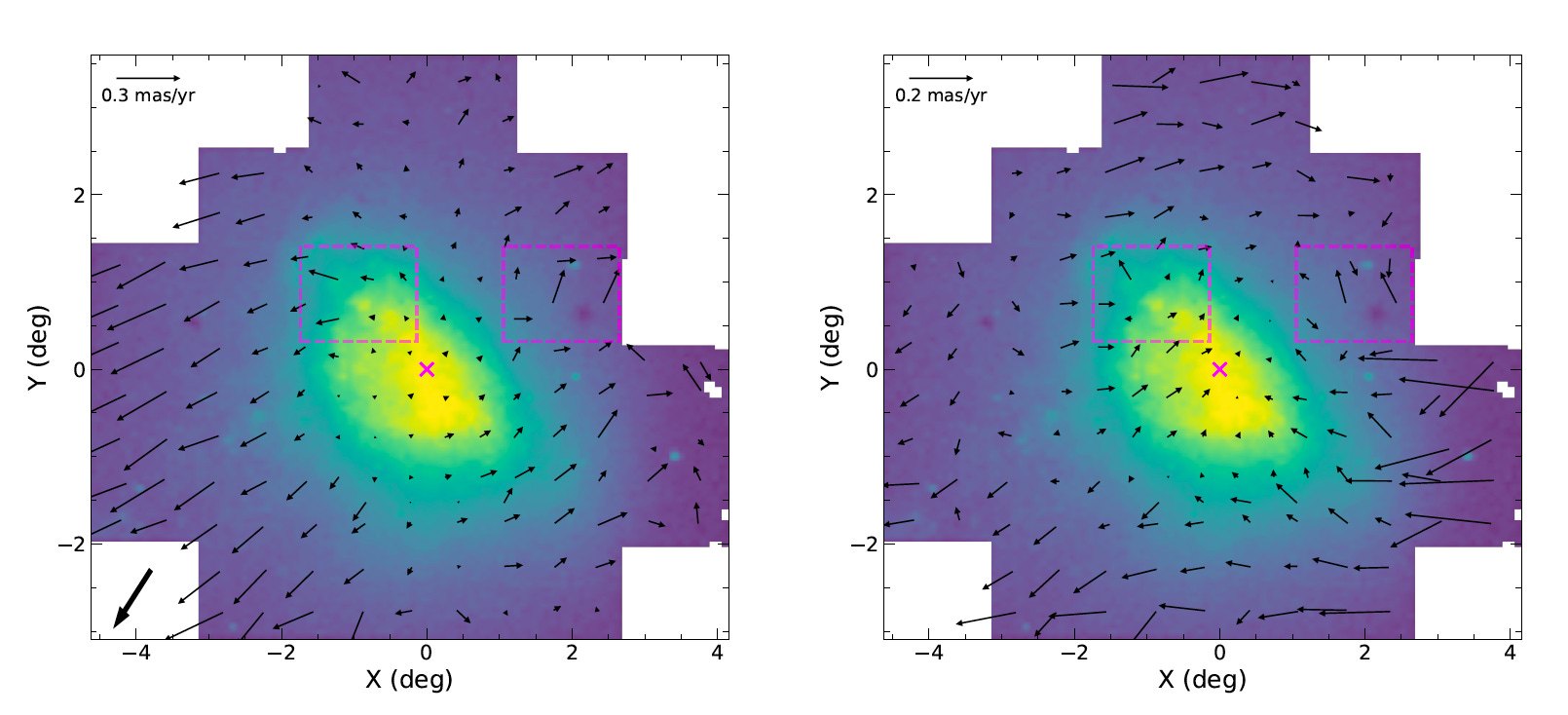
If one removes the bulk motion, the residual should show how the stars move in the frame of the galaxy. One would expect that the stars are orbiting around the centre of the galaxy and this is not the case. What we are seeing is the galaxy being stripped due to tidal interactions.
An extra step is to remove the gradient of the stellar motion. Now we see that most of the stars in the centre are attracted by the centre of the galaxy.
The dynamics of the SMC is highly complex and it gets more complicated if one starts splitting in different populations (for example, based on ages). The paper (actually, a letter) is very interesting and well explained. Letters tend to have a big problem: since they are limited to 4 pages, the authors have to squeeze a lot of information. In this case, the context and the work can still be followed quite well.
🤖🖥AI in Astronomy
Artificial Intelligence is entering all aspects of our lives. In this section, we try to share useful prompts, use cases, and reflections which may help you using AI in a constructive and engaging way.
A few weeks ago, we mentioned some papers posted on arXiv about the role of AI in astronomy and the role of humans in astronomy. I have seen this article on Science which catches the same wave. It is not much surprise to me, since I live these conversations on a daily basis but it can be interesting to you.
By now, most of us are aware of AI systems like ChatGPT or Claude. These systems are capable of making sense of a lot of things based on their immense training dataset. A good example is that you can leave a few typos in your prompt and they will likely understand your message anyway.
In a similar way, the authors of this paper Toward decision-aware AI for LSST-scale time-domain astronomy are considering using known variables to infer the variables that the Large Survey of Space and Time (LSST) is carrying.
📈📊Astronomy tip of the Week
How do you get observing time with telescopes?
You normally have an idea, gather a group of people to work on that project, and propose to an observatory to use its resources for some time.
I will explore this process in other newsletters but I wanted to bring your attention to this paper:
An update to Allocating Time on Scientific Platforms in Outer Space using five cycles of JWST General Observer programs https://arxiv.org/abs/2606.04977
When they started to offer JWST observing time, they started to check if the “double anonymous” system (the proposer’s name is hidden to the reviewer and vice versa) resolved some historical bias.
In short, yes, we went from old white dudes from rich institutes to a more “democratic” distribution. Yet, there may still be some issues.
🫣❓What is on the horizon?
Big conferences, big news or big events.
EAS 2026, Lausanne (Switzerland), 29 June - 3 July 2026
XVII Scientific Meeting of the Spanish Astronomical Society, Tarragona (Spain), 13-17 July 2026
Understanding the Universe Through Large Scale Astronomical Surveys, Teruel (Spain), 5-9, October, 2026
XVIII LARIM Latin American Regional IAU Meeting, Cancún (Mexico), 30 November - 4 December 2026
Gaia Data Release 4, 2 December 2026
IAU General Assembly, Rome (Italy), 10-19 August 2027
There's also a hope that the Rubin Observatory may be able to spot Planet Nine, if it exists.
https://thedebrief.org/a-massive-hidden-planet-may-be-lurking-beyond-neptune-this-caltech-scientist-thinks-planet-nine-may-soon-be-confirmed/